Author Archives: benaiahfogle
Wahoo ( Acanthocybium solandri )

Joshua with his first Wahoo!
Common Name: Wahoo
Local Name: Tangigue (Tagalog), Tanigue (Cebuano)
Max Size: 250 cm ( 83 kgs )
Biodiversity: Marine, Pelagic-Oceanic, Oceanodromous
Depth: 0 – 12 m
Fishing Season: All Year Long
Minimum Size Limit: None
Wahoo are another one of the popular big game fish here in the Philippines. They are abundant through out the islands ranging in size from small juveniles to large adults. Wahoo are often sometimes known as Black Tangigue to distinguish them from the Spanish Mackerel or White Tangigue. These fish are most often caught while trolling large lures of fresh bait behind a boat. Wire leaders are a must when fishing for these fish or fishing in a place where these fish may be caught. They have razor sharp teeth which can easily slice through heavy monofilment and fluorocarbon line.
Joshua caught the Wahoo in the picture above in northern Luzon while trolling. Notice the beak-like mouth which helps distinguish it from the Spanish Mackerel.
Deep-Bodied Mojarra ( Gerres erythrourus )

Latab caught on Mactan Island
Common Name: Silvery Biddy, Mojarra, Bream
Local Name: Malakapas (Tagalog), Latab (Cebuano)
Max Size: 30 cm
Biodiversity: Marine, Brackish, Reef-Associated, Oceanodromous, Endemic
Depth: 1 – 40m
Fishing Season: All Year Long
Minimum Size Limit: None
This is a relatively small species of fish that can be caught and hook and line as well as used as a good bait for fishing for larger game fish. These fish often school around the shoreline and reefs. You need relatively small hooks to catch this fish as they do have small mouths. The fish in the picture above was caught on a small shrimp.
Tripletail ( Lobotes surinamensis )

Common Name: Tripletail
Local Name: Tilapiang Dagat (Tagalog), Gingao, Ligad (Cebuano)
Max Size: 110 cm ( 19.2 kgs )
Biodiversity: Marine, Brackish, Benthopelagic, Oceanodromous, Endemic
Depth: 1 – 70m
Fishing Season: All Year Long
Minimum Size Limit: 15 inches
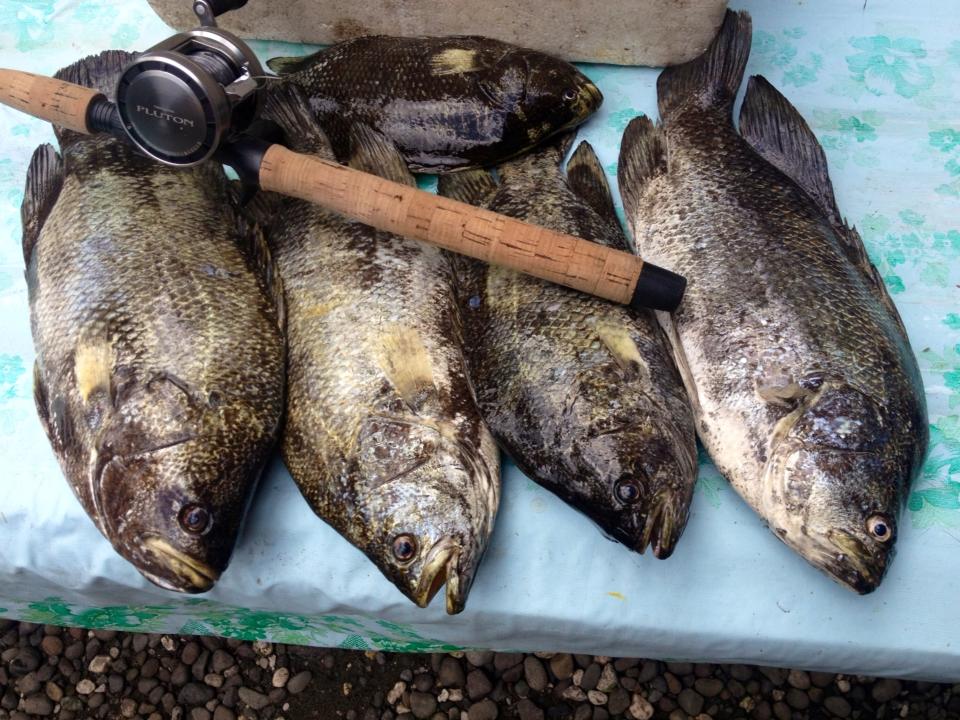
The fish in these pictures were caught off Dumaguete, Negros Oriental around FADs (fish aggregating devices) or buoys. These fish can be caught along the coast as well. Yet another one of the many game fish species that can be caught here .
Blue Shark ( Prionace glauca )

Common Name: Blue Shark
Local Name: Pating (Tagalog), Iho (Cebuano)
Max Size: 400 cm ( 205.9 kgs )
Biodiversity: Marine, Pelagic-Oceanic, Oceanodromous, Endemic
Depth: 1 – 1000m
Fishing Season: All Year Long
Here is one of the many species of sharks that can be caught here in the Philippines. These sharks travel long distances through the open ocean but can also be found closer to shore where the reef shelves are steep. The shark in the picture above was caught by Ricky off of Siargao Island on rigged fresh bait.
Diamond Trevally ( Alectis indica )

Common Name: Indian Threadfish
Local Name: Talakitok (Tagalog), Mamsa, Salmin Salmin (Cebuano)
Max Size: 165 cm ( 25 kgs )
Biodiversity: Marine, Brackish, Reef Associated, Endemic
Depth: 20 – 100m
Fishing Season: All Year Long
This is another species of trevally that can be found in coastal waters here in the Philippines. It is distinguished by its odd angular body and shiny appearance. These fish are often found in schools over coral reefs and feed mainly on fish, squid and crustaceans. The fish in the picture above was caught by Mr. Archival on live shrimp at the Marcelo Fernan Bridge in Mandaue, Cebu.

Diamond Trevally caught in Dumaguete
Rusty Jobfish ( Aphareus rutilans )

Common Name: Jobfish, Snapper
Local Name: Maya Maya, Bisugo
Max Size: 110 cm (commonly 79cm)
Biodiversity: Marine, Reef Associated, Endemic
Depth: 100- 330m
Fishing Season: All Year Long
This species is often mistaken for Ruby Snapper or Flame Snapper, however the color and different shape of the mouth eyes and body help distinguish them. It is a member of the snapper family. These are deepwater fish found very deep, over 300ft below the surface. The fish pictured above was caught by Anthony while jigging 150g jigs off the coast of Northern Luzon.
Snubnose Pompano ( Trachinotus blochii )

Common Name: Snubnose Pompano
Local Name: Permit,
Max Size: 110 cm
Biodiversity: Marine, Brackish, Reef Associated, Endemic
Fishing Season: All Year Long
This is a species closely related to the Permit ( Trachinotus falcatus ) of the Atlantic. It is often called Permit here however its correct name is Pompano. This fish is found throughout the Indo Pacific where the juveniles school often along sandy shorelines, sandy or muddy bays and river mouths. The adults tend to be more solitary and are more commonly found around coral reef and rocky reefs. These fish feed primarily on mollusks and hard shelled invertebrates. Great baits for these fish include hermit crabs, small sand crabs and other mussels and shells.
The fish pictured above was caught by Jun in Puerto Azul located in Cavite.
Pompano Dolphinfish ( Coryphaena equiselis )

Common Name: Pompano Dolphinfish,
Local Name: Dorado, Lali (Bisaya)
Max Size: 127 cm (commonly 50cm)
Biodiversity: Marine, Pelagic, Endemic
Fishing Season: All Year Long
This is a small species of fish that is often misidentified as juvenile Dorado (Mahi Mahi). It is in fact a different species known as a Pompano Dolphinfish. They are smaller than their Dorado cousins but also travel is schools. One way to identify the species is by the long dorsal fin which extends the length of their whole body.
These were caught off of Dumaguete by angler Mike and his companions while they were fishing around FADs or payaw. These fish were in a feeding frenzy and Mike related to me that they were hitting just about every lure that was thrown at them. Over 40 fish were caught in an hour.
So next time you are out hunting around payaw and come across “baby” Dorado, take a closer look at it and see if you have a Pompano Dolphinfish. These are an excellent food fish tasting like Dorado, but sweeter according to Mike.
Orange-Lined Triggerfish ( Balistapus undulatus )
Common Name: Triggerfish
Local Name: Papakol (Tagalog)
Max Size: 30 cm (commonly 26 cm)
Biodiversity: Marine, Reef-Associated, Endemic
Fishing Season: All Year Long
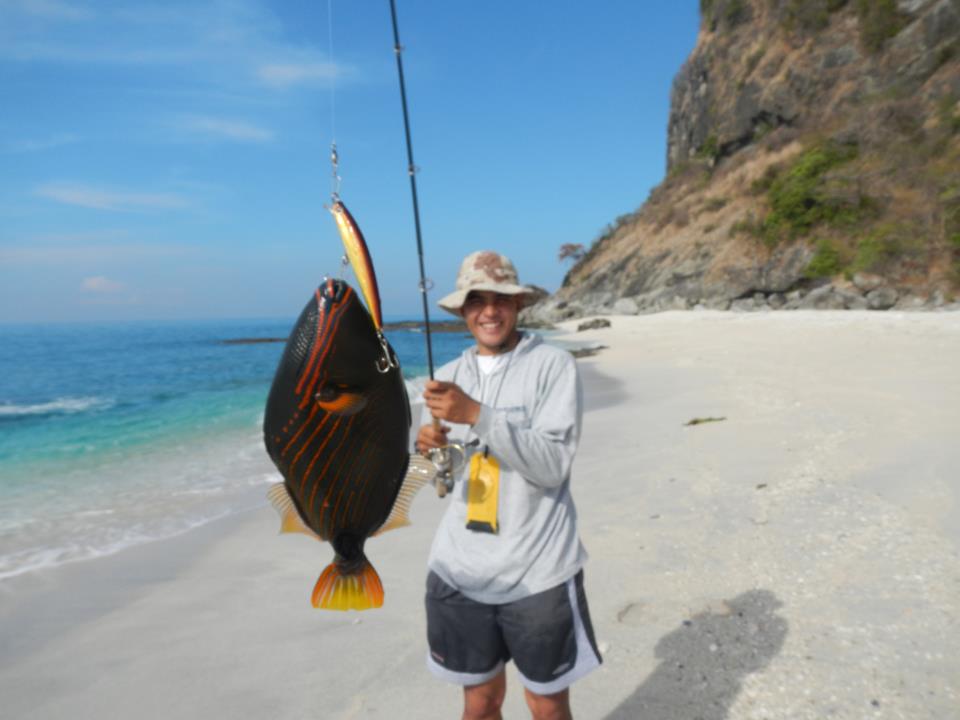
Caught by Julian on his first 24 hour liberty after 4 months of boot camp.
Many species of triggerfish inhabit the waters here. Once such fish is the Orange-Lined Triggerfish. These are a relatively small species of triggerfish growing up to about 30cm.

Triggerfish caught in Cebu
Crocolandia
For those looking for a real laid back fishing experience in small ponds full of fish there is Crocolandia. It is a zoo/animal rescue and conservation effort that is located in Biasong, Talisay City, just south of Cebu City. Here is a map of the spot:
PROS:
Great place for family fishing trip
Benches to sit Shaded fishing area, Snack bar, other animals to see
Lots of fish and some big ones too
Bamboo poles available at no extra cost
CONS:
Only two small ponds to fish
Entrance fee (kids-50php, adults-100)
FISH SPECIES:
Tilapia, Red Pacu, Striped Snakeheads and possibly others
DESCRIPTION:
Crocolandia was started as a sanctuary for the fast disappearing species of Philippines saltwater crocs and alligators. It has since expanded to include a wide variety of both native and introduced species of animals. They have resident biologists and consulting vetrenarians that ensure that the animals, birds and reptiles are healthy and well taken care of.
The fishing ponds at Crocolandia are a relatively new addition to the zoo and provide another fun activity there. The ponds are relatively small and are not that deep but they do hold an abundance of tilapia, snakehead and large pacu. To fish there at Crocolandia just inform the staff and they will assist you.
You can keep the fish that you catch there and purchase them to bring home. However we also recommend that you release the snakeheads to hep keep the already booming population of small tilapia at bay.
RATING:
( 6/10 ) I rate this spot as a 6 because I prefer fishing in natural wild environments. However if you are looking for a fun spot to take the family this place is excellent.
REMINDERS:
Don’t forget about the entrance fee.
Ask for a guided tour of the zoo to learn a lot of interesting stuff about the animals.
Say Hi to Lapu-Lapu, the largest Croc that is there. If you are lucky you may catch them at feeding time.
PHOTOS:
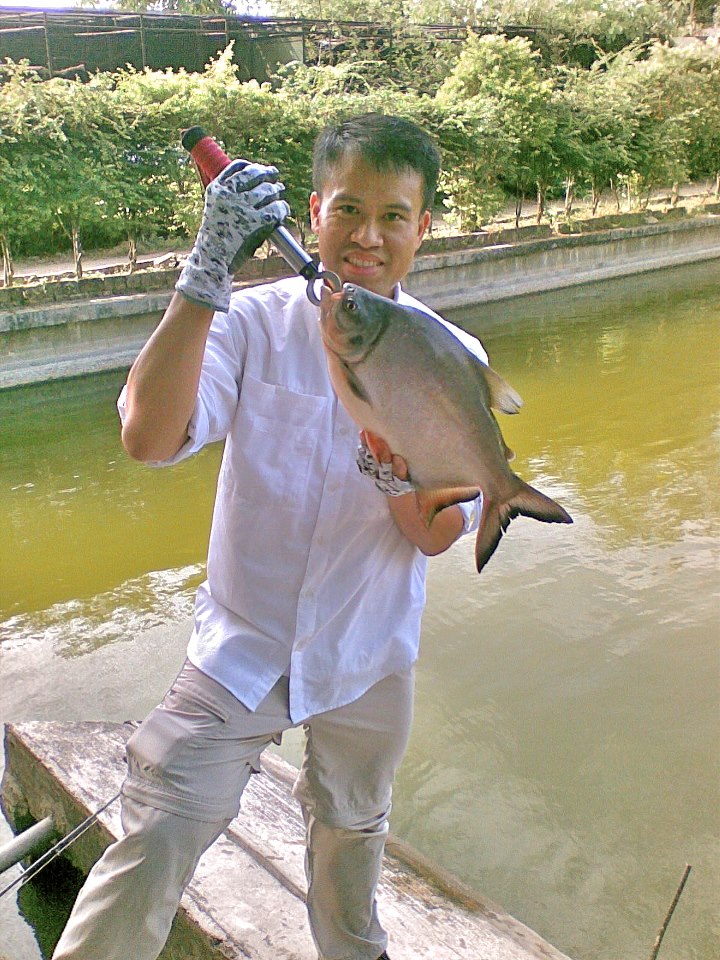
Vince caught a good size pacu there.

A great place for a fun day with the family!

The two fishing ponds at Crocolandia
Here is their well kept Facebook page: https://www.facebook.com/Crocolandia


 Fishing The Philippines